

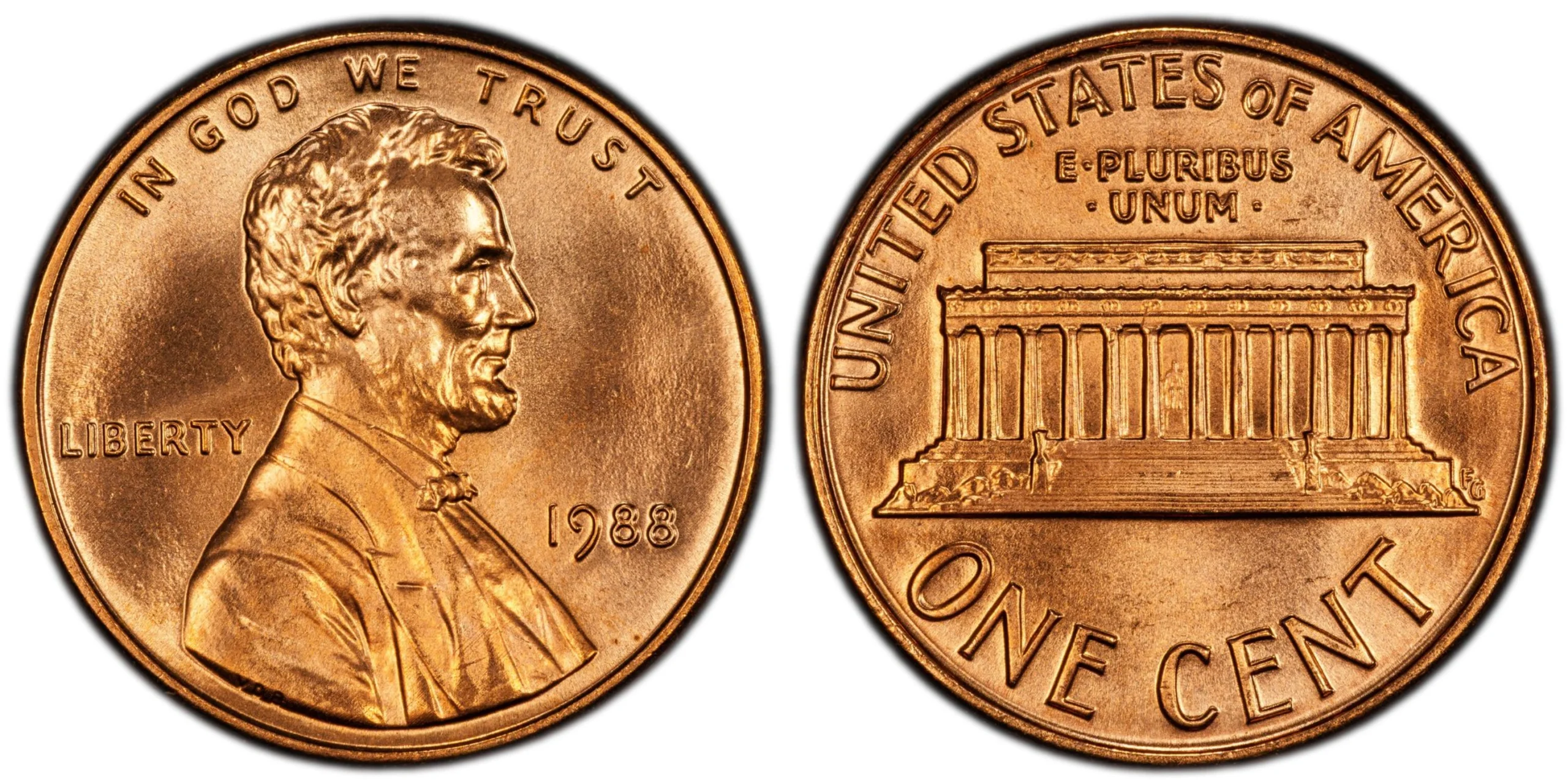
The circulated 1988 penny value is 1 cent, but unique varieties, such as Reverse of 1989 or Red color pieces, price up to $3,000 and more.
Understanding 1988 Penny Grading and Color Classifications
| Year | 1988 |
| Diameter | 19 mm |
| Weight | 3.11 g |
| Composition | Bronze |
| Edge | Plain |
Professional coin grading services like PCGS and NGC evaluate copper-plated zinc cents based on a strict numeric scale. For modern Lincoln cents, the surface color dictates market viability and final value.
Graders split uncirculated coins into three specific color categories based on the amount of original mint luster that remains on the metal.
Red
The coin retains at least ninety percent of its original, brilliant red mint luster. Collectors exclusively target Red specimens for top-tier investments.
Red and Brown
The surfaces show a mixture of original red luster and developing brown oxidation. The red coloration covers between ten percent and ninety percent of the coin’s surface.
Brown
Ambient air exposure and oil from human hands have fully oxidized the surfaces. Less than ten percent of the original red mint color remains.
The Details
Original mint luster dictates the top-tier pricing structures because red zinc coins are highly volatile. Zinc reacts aggressively to moisture and oxygen. Over time, oxygen turns the bright red surface into a dull brown.
Amateur collectors often fall into a major pitfall with grading scales. They mistake a clean, shiny penny from daily use for a true Mint State rarity.
A coin loses its Mint State potential the exact second it enters general circulation. Friction against other coins leaves microscopic hairlines on Lincoln’s cheek and the Memorial pillars. True Mint State coins must come directly from original US Mint bank bags or uncirculated rolls.
1988 Penny Value by Mint Mark
| Condition | Philadelphia | Denver | San Francisco |
| MS-63 | $2.00 | $2.00 | – |
| MS-65 | $8.00 | $6.00 | – |
| MS-67 | $35.00 | $25.00 | $5.00 |
To know better actual auction prices, you should check market fluctuations and coin-identifier.com.
Philadelphia Penny
Mintage – 6,093,966,000
Millions of these worn coins enter cash registers daily. If you pull a typical brown penny, its value sits at exactly one cent. Low-grade Mint State coins between the grades of MS-60 and MS-65 remain highly common. Bankers and collectors saved thousands of original uncirculated 50-coin rolls in 1988.
Denver Penny
Mintage – 5,253,127,580
Similar to Philadelphia, Denver cents from 1988 that spent time in circulation possess zero financial bonus. They are worth face value.
The market value for choice mint-state singles remains highly accessible for everyday collectors.
An average uncirculated roll of fifty D cents trades for $3 to $6.
The 1988 “Reverse of 1989”
The absolute highlight of the 1988 Lincoln cent series involves an accidental design mismatch. Numismatists consider this coin a transitional variety. Variety hunters scour millions of loose pennies specifically to locate this valuable specimen.
The numismatic community has the transitional variety if two errors unite:
- 1988 Obverse
- 1989 Reverse Die
How to Spot the FS-901 Flared G
Workers paired a few of these brand-new 1989 reverse dies with existing 1988 obverse dies at both the Philadelphia and Denver mints.
This mistake created the famous FS-901 transitional variety. You must use a ten-times magnification loupe to execute the “FG” initials test.
The Normal 1988 Reverse
1. Check that letters “F” and “G” are thin, delicate, and show low relief.
2. The letter “G” features a completely straight vertical back stem and lacks a prominent serif hook at the top or bottom of the letter.
The Rare 1989 Transitional Reverse
1. Check that letters “F” and “G” are noticeably thicker and show sharp, high relief.
2. The letter “G” features a distinct vertical bar that extends below the main loop.
3. Paired with a highly visible horizontal hook at the tip of the lower curve. This diagnostic mark is known as the “Flared G.”
The Spacer Test
1. Check the distance between the letters “A” and “M” in the word “AMERICA.”
2. The normal 1988 reverse positions the “A” and “M” extremely close together.
3. The rare transitional reverse spaces the letters further apart, creating a “Wide AM” look.
The Details
During the final months of 1988, mint employees prepared new working dies for the upcoming 1989 production cycle. The Chief Engraver modified the official reverse design hub for 1989 to improve die longevity. The mint altered the shape of the designer’s initials, “FG” (which stand for Frank Gasparro), located to the right of the Lincoln Memorial base.
Auction Records
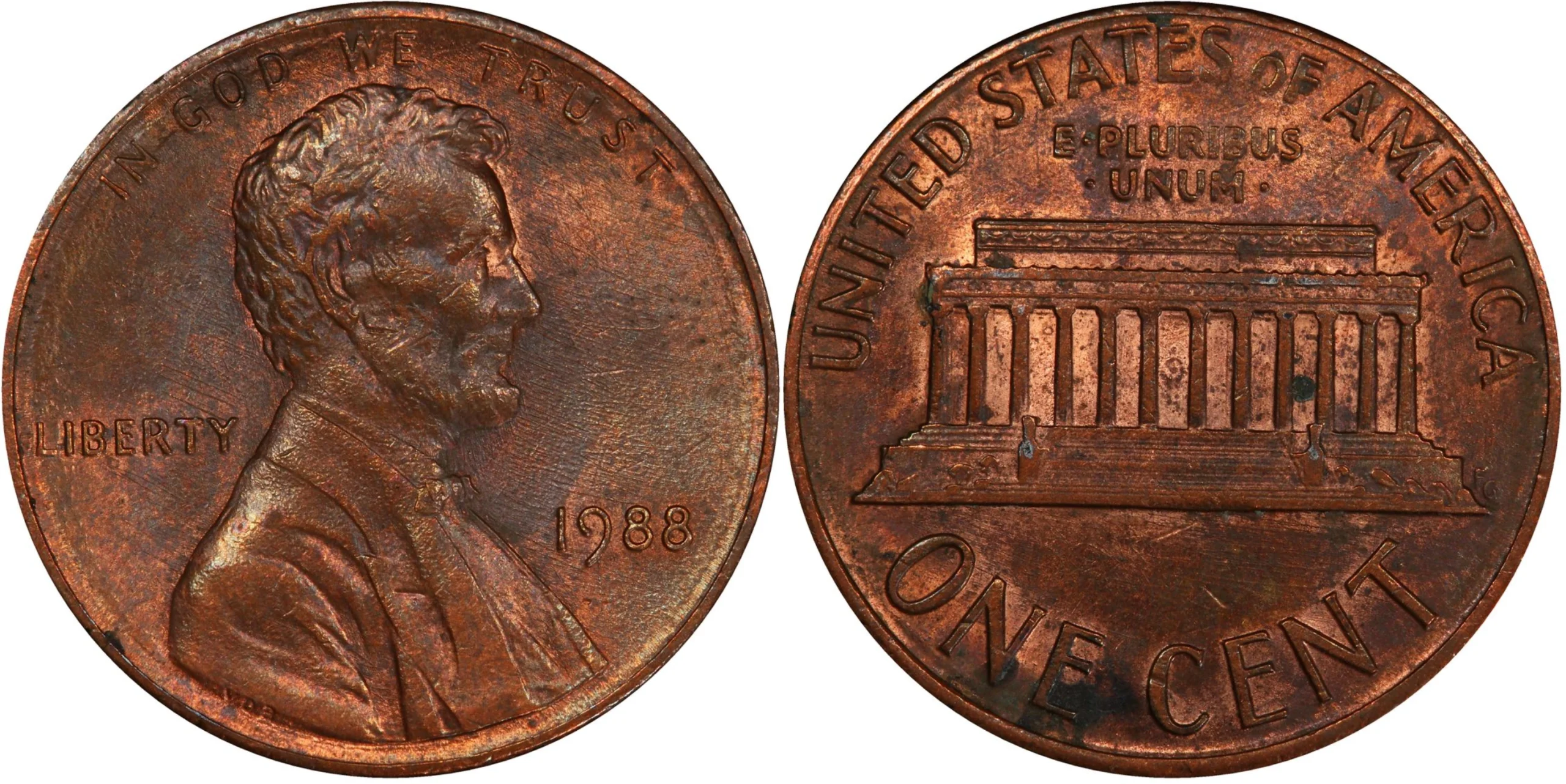
The valuation data below outlines the stark pricing differences across the 1988 penny series. This matrix highlights the financial power of color classification and rare transitional die varieties.
| Price | Type | Platform |
| $7,040.00 | MS-69 Red | eBay |
| $3,120.00 | Reverse of 1989 | Heritage Auctions |
| $1,495.00 | D MS-68 Red | Heritage Auctions |
| $180.00 | PF-70 Ultra Cameo | – |
Item Errors
Wrong Planchet & Off-Metal Striking Errors
An off-metal error happens when a blank meant for a completely different denomination accidentally falls into the Lincoln cent feeding bin. The results are visually spectacular.
For instance, a 1988 cent struck on a clad Roosevelt Dime blank creates a silver-colored cent. Because a dime blank is physically smaller than a penny die, the outer edges of the Lincoln design spill completely off the coin.
Die Cracks, BIE Errors & Broadstrikes
High production pressures caused the steel coin dies to split over time. When a die cracks, metal flows into the newly formed fissure during impact.
Die Cracks – these leave raised, jagged lines of metal across the fields of the penny. Minor die cracks on the corners of the Lincoln Memorial roof add small prices.
BIE Errors – a highly specific die crack frequently occurs between the letters “B” and “E” in the word LIBERTY. The resulting vertical metal blob resembles a capital letter “I.”
Broadstrikes – this error occurs when the circular steel collar that holds the penny blank in place fails during the strike. Without the collar, the metal expands outward under pressure, leaving a wide, thin penny with a perfectly smooth, unrimmed edge.